


Last week’s piece on Champagne’s R.I. actually came about after looking at English Sparkling Wine production figures for the last few years, and asking the question - does English Sparkling Wine need to embrace reserve wines more?

England remains a fascinating test bed for sparkling wine, and even for those readers outside England I’d encourage reading on. Some of the questions we face here are the same as Champagne first tried to solve almost a hundred years ago, whilst others are completely new.
First, a graph. To inevitable groans from some quarters, it’s about how much English Sparkling Wine is being made, with projections up to 2036. Using a combination of Food Standards and WineGB data, it shows:
How much sparkling wine is being bottled. This forecasts 10 million bottles in frost-affected 2026, and then follows average production levels for the productive planted area (if it remains frozen at 5,000 hectares) reaching full production in 2026/7. It assumes a split of 73% sparkling production continuing as per the long-term average.
Sparkling wine ready for sale - 4 years from harvest on average (some will be less, some more, most business models will be built on this sort of timeframe though)
Sparkling wine sales, assuming a 2% year-on-year growth for 2025 onwards
A running surplus of sparkling wine - how much has remained unsold to that date
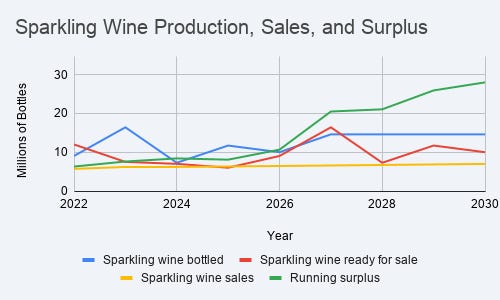
On paper, the enormous 2023 harvest looks set to kick off a growth in surplus that is very hard to slow down.
The issue with predictions about English oversupply, though, is that they don’t tell the story producer-by-producer - and there’s plenty of optimism in some quarters. “We had exactly this situation with the 2018 vintage” says consultant and ex-Hattingley Valley winemaker Emma Rice. “Everyone at the time was very negative, saying ‘you’re never going to sell it’ - but the 2018s have mostly sold through”. Against a backdrop of rapidly-declining Champagne sales, England has so far held steady, maintaining 2023’s sales figures into 2024 (in effect a growth in market share - 2025 figures are not released yet).
There’s still plenty of expansion either by vineyard plantation or fruit purchase going on amongst successful smaller and mid-sized producers too, with Nyetimber and Chapel Down still holding significant vineyard hectarage yet to produce. Optimism, in other words, is very much still in the room.
A good time to buy grapes?
As with the New Zealand Sauvignon Blanc boom and bust, though, the first sign of an imbalance is softening fruit prices. “I’m being offered a lot of fruit”, says Rice, who points out that Essex still wine fruit is dropping from highs of £4000 per tonne to closer to £3000, and that last year sparkling wine producers were “hoovering up” grapes for under £1000 per tonne (around one eighth the price of Champagne grapes) on the spot market - “barely enough to cover the picking”.
Fruit prices dropped in 2023 thanks to the abundance and lack of tank space, but this year’s frost-affected harvest won’t be anything like that size. This is a full-on buyer’s market.
Speak to successful producers, then, and all is hunky-dory. Those buying fruit are happy with lower prices (at least for the spot market), and sales amongst the well-established names remain largely solid. Even when you look at the financial troubles of producers such as Gusbourne, Chapel Down, Ridgeview, Hambledon and Rathfinny, they’re tales of ballooning costs, debt interest and cash shortages more than they are poor sales performances.
The question mark in terms of market is larger for the newer names, the heavily-invested farmers with higher growing costs, mid-size producers and those without the resources available to put into selling. The parts of the industry that don’t always grab (or try to make) the headlines, in other words.
“It’s the guys in the middle who are producing too much to sell locally but don’t have the resources to pay 100k a year plus for sales guys”, says Rice, who also believes that both larger producers able to export and sell to larger multiples, and small producers selling “10 to 20,000 bottles” locally, are relatively well-set.
With so many privately-funded companies not publishing accounts, it’s hard to get a picture of where this unsold wine is hiding; a significant portion is still on its way from the expansion of Nyetimber, Chapel Down and MDCV, all of whom theoretically have the machinery needed to raise their sales to match it.
How much, though, is the product of what Rice calls the ‘build it and they will come’ mentality? Somewhere in these figures lurks a lot of wine without a plan.
Smoothing out the bumps
Let’s knock one idea on the head; England is never going to have a centralised mechanism for controlling how much wine is made. “There would be uproar, resignations, questions in the House, revolution even!” says industry veteran Stephen Skelton MW.
What about reserve wines, though? Even putting aside quality advantages, wouldn’t more of a reserve wine buffer avoid gluts of particular vintages hitting the market at the same time or aging for too long on (or off) lees? Isn’t it more cost-efficient, prudent and beneficial for quality to keep good reserve wine in bulk than to over-bottle?
English sparkling wine producers don’t keep a lot of reserve wine by Champagne standards, with Nyetimber possessing the most comprehensive reserve wine system in the country. Skelton is sceptical, though, that producers will move in this direction, preferring simply to bottle what they have. “The only real way to dispose of excess stock is to cut and run, slash the price and take the hit”, he says. “Not many people are prepared to do that - it’s easier to build another warehouse and store it in bottle”, adding that the “expertise” in managing proper reserve wine systems is not really there.
Bottling is expensive though, and part of the reason that companies ran into cash problems dealing with large vintages. “Honestly it would have bankrupted Hattingley to bottle all of 2018 and 2019” explains Rice, who used the generous yields to build a 100,000 litre reserve wine system. “It’s the cost of bottles, cages, storage space… Hattingley had to build a warehouse just to house 2019!”
Rice is keen to point out just how difficult it is for young producers to hold back wine, even if it does make long-term sense. “We do learn a lot from champagne, but we haven’t taken all the lessons on board”, she says. “When you first start, you want to get as much into bottle as soon as possible. By default the first few wines are vintage, then it becomes ‘this is what we do’. It would take a very brave person to start off in the reserve wine track”.
Brave, and wealthy. The extra tanks, space, maintenance and delayed recoupment on investment involved in creating a system that, as in Champagne, stores an entire harvest in reserve, is considerable. Reserves need to be stored in large volumes to protect them, and there has to be an experienced winemaker to know which wines are best suited.
Some, such as Black Chalk and Gusbourne, have the sites and expertise to make vintage-only work beautifully. For smaller producers ( and especially those working with contract winemaking), a long-term reserve strategy is almost impossible, and they’ll be faced with bottling single vintages that vary wildly in quality and quantity.
How does balance return?
In short, planting for sparkling not expanding, a globally trend-bucking increase in sales and exports (the graph below showing 5% year on year), and a rebalancing towards an even split with still wine production (dropping 2% per year) will start to shrink the gap between wine ready for sale and sales by the early 2030s.
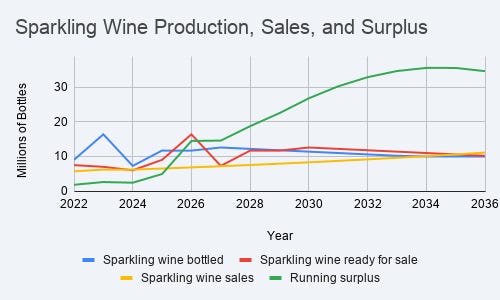
Just as likely, though, is a very rapid switch in still wine production; it wouldn’t surprise me if sparkling turns out to be sub-65% in 2026, or even lower.
Once again, though, a broad industry-wide pattern like this doesn’t really tell the story on the ground, producer-by-producer. Many will have no surplus at all. Some will successfully sell off wines, whilst others will move to selling more grapes at attractive prices, undercutting those on longer-term contracts and fueling the profitability of producers who have the engines and manpower to raise sales (something we’re already seeing happen).
Larger, more efficient vineyards will hold advantages if grape prices slide, too. When I spoke to Henry Sugden of Defined Wines about how it was possible for a group of producers to turn out their ‘Mighty Wren’ English still wines at a £4 to £5 trade price, his answer was clear - they only work with farmers who have enough vineyard scale to keep the fruit prices competitive.
It’s tempting to pivot to still wine, although even if you do have suitable grapes (far from guaranteed), the risk is in the pressure to sell it young, as Rice points out in reference to the popular choice of re-purposing Pinot Noir originally destined for sparkling to still rosé. “There’s a time limit on rosé - it’s a risk if you don’t sell it, but with sparkling there’s not the same sense of urgency”, she says, as the wines can rest protected on lees for longer, potentially improving.
The overproduction of English sparkling isn’t some kind of cloud hanging over the whole industry. It’s patchy weather, localised, unpredictable, disruptive to some, barely noticeable to others, terminal to a few. Eventually, it will resolve itself.
If I had crystal ball, at the moment I’d expect it to say something like this; if producers can avoid growing too fast, cut through to trade and press with strong identities and great wines, make the most of commercial opportunities and listen to what sells (and not what they want to make), they can thrive. If anyone finds a pot of gold at the end of a rainbow, I’d just as soon advise them spend it trying to make great English Sparkling as I would send them anywhere else; the potential is that high.
30% of that pot, though, ought to be going straight into reserve wine…
My report on England’s wines for the Wine Advocate in the US is due out this summer, in which I’ve selected around 50-60 wines out of hundreds tasted. Keep posted.
This was fascinating. I’d always thought of reserve wine mainly as a stylistic tool, not as the point where quality, production, and cash flow all start running into each other. The part I’m still thinking about is that the producers best positioned to build meaningful reserves may also be the ones least likely to need them as a pressure-release valve. Am I reading that right?