

Champagne's vineyard is producing less
Is that a problem? Or a blessing in disguise?

Ok, we had a nice time with Bach and riots. This week, it’s time to put on the study hats as we dive into some facts and figures. I promise it’s actually really interesting….
“We have to keep in mind the objective of selling 300 million bottles - it’s an essential level to preserve balance in Champagne”
Maxime Toubart, president of the association of Champagne’s growers (the SGV), writing in their magazine ‘La Champagne Viticole’
La Champagne Viticole is a magazine for growers who sell grapes for a living. It’s not for consumers, or marketers, or press (although they do let me subscribe, which not all the trade bodies do!). What it offers, though, is insight into what grape growers are thinking about. Business, in other words. And business means yields.
Champagne sales remain sluggish, with April’s sales figures showing a levelling-off from the modest recovery shown in the preceding two months (with a particular slowdown in ‘grower’ champagne and in the French market).
Despite this, the grower’s association and its president are concerned that the vineyard is degrading, and an upturn in demand could see production caught short.
Is this just a standard case of Champagne high-yield greed, or is there a real problem?
The facts, as presented by the SGV and CIVC:
Over the last 15 years, the vineyard has lost one quarter of its production.
This is not because of vines being pulled up - this is because of changes to viticulture (more working of the soils and less fertilisation), disease and virus pressure, and ageing vines - the latter reportedly responsible for one third of the drop.
The average age of vines in Champagne has grown from 21 years in 1998 to 36 years today.
The culture of pulling up older vineyards when yields started to drop has fallen away to some degree as the understanding of how to plant and prune better has started to enable growers to keep healthier vines for longer. Still, according to the CIVC, a vine of more than 30 years age produces 8 to 10 bunches per m2, compared to 13 to 14 for a vine of 15-25 years - a difference of 3 to 5 tonnes per hectare! Sébastien Debuisson, technical director of the CIVC, thinks the region should work towards a realistic average age or 40-50 years.
A “young and healthy” vineyard could have a maximum potential yield of an enormous 22,500kg, or nearly 19,000 bottles, per hectare (a number I have certainly seen in Champagne, especially in Chardonnay, although it is far above the authorised appellation maximum), but the current average potential is around 16,000kg with an actual agronomic (what is on the vines) average of 11,900 kg, or about 10,000 bottles per hectare, over the last 10 years. In the 1950s, this was around 5,000 kg, or only 4,000 bottles. For comparison, the average yields in Premier Cru Chablis are the equivalent of 5-7000 bottles per hectare, with Grand Cru red Burgundy much lower again.
On the surface, the story looks like this; greedy Champenois value their huge yields over the heritage of their old vineyards, and are overly-optimistic that sales will recover enough to absorb them.
Is the truth a little more complex?
The case for the defence - yes, Champagne needs to replant more
The arguments:
“Old vines” doesn’t always mean “good vines”
Vines from quantity-driven clonal selections that have been poorly pruned, or were poorly planted, or established in poorly-worked vineyards where compacted and dead soils give rise to poor root structures, aren’t assets just because they’re old. Not only yields, but drought resistance and climate-change resilience would often be improved by new, high-quality plantings (including the possibility to aid genetic diversity of the vineyard by planting more massale selections or varied rootstocks).
The rates of decline shown by the SGV eventually drop Champagne’s vineyard below what is needed to maintain even current (low) sales:
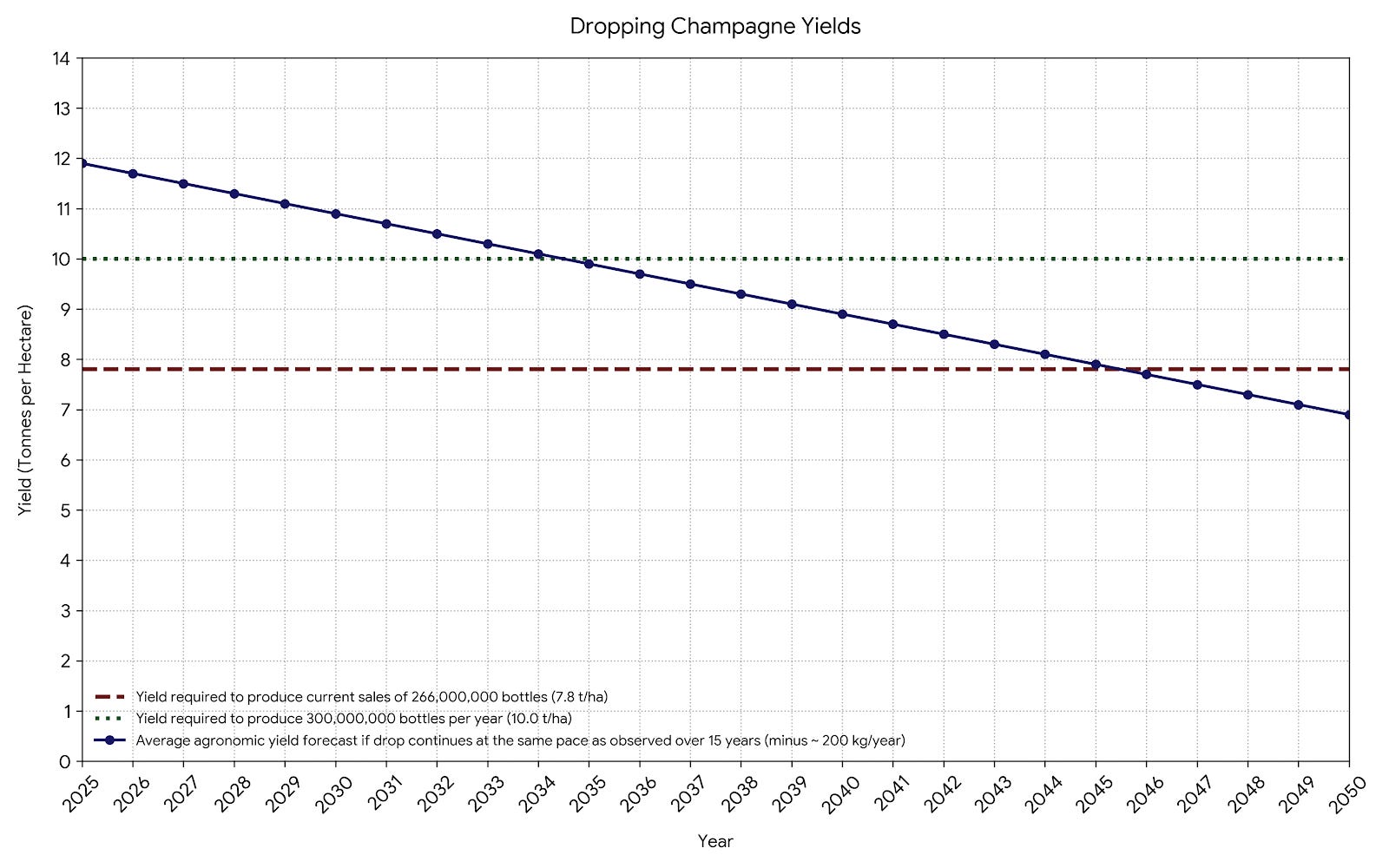
To maintain 2025’s sales of 170 million litres of Champagne over a vineyard area of 34,300 hectares requires approximately 5000 litres of must to be produced per hectare. This requires approximately 7.8 tonnes per hectare of grapes. This is very, very low for Champagne.
Still: starting from the 10-year average of agronomic yield, if the vineyard continues age 2 years for every 1 and yields continue to drop by 200kg per hectare per year (an extrapolation of the 15-year yield drop reported), then by 2045 the region’s agronomic yield would drop below 7.8 tonnes per hectare. If sales recovered to 300 million bottles, the current rate of decline would see the average production dip below the required level by 2034.
Is that sort of decline really realistic though?
